
When cell service dies and the stakes go up, your gear needs to be exactly where you expect it.
If you spend enough time in the backcountry—real backcountry, the kind that starts where cell service dies—you’ll hear some version of the same story.
A guy sees something he didn’t expect. A bear, usually. Sometimes closer than it should be. Sometimes moving faster than it has any right to. And somewhere in the retelling, there’s always a moment—quiet but unmistakable—where he realizes the gun he brought isn’t where he needs it to be.
It’s buried under a pack belt. Jammed into a waistband under layers. Locked in place by the very gear that was supposed to keep him alive.
That’s the problem chest holsters solve. Not theoretically. Practically.
And once you accept that premise—that access matters more than anything else—you stop thinking in terms of brands and start thinking in terms of materials. There are really only two paths here: leather, or Kydex.
Everything else flows from that choice.
There’s another shift happening at the same time, and it matters more than most people realize.
For a long time, a revolver set up for serious field use and a revolver set up with a red dot lived in two different worlds. One rode in a holster. The other stayed at the range.
That line is gone.
With modern chest holsters built to accommodate optics, a large-frame single-action or double-action revolver—.44 Magnum, .45 Colt, .454 Casull, even .357s—can carry a red dot into the field without compromise. What used to be a specialized setup is now a practical one. Faster sight acquisition. Better performance in low light. Aging eyes suddenly back in the game.
But that only works if the holster supports it.
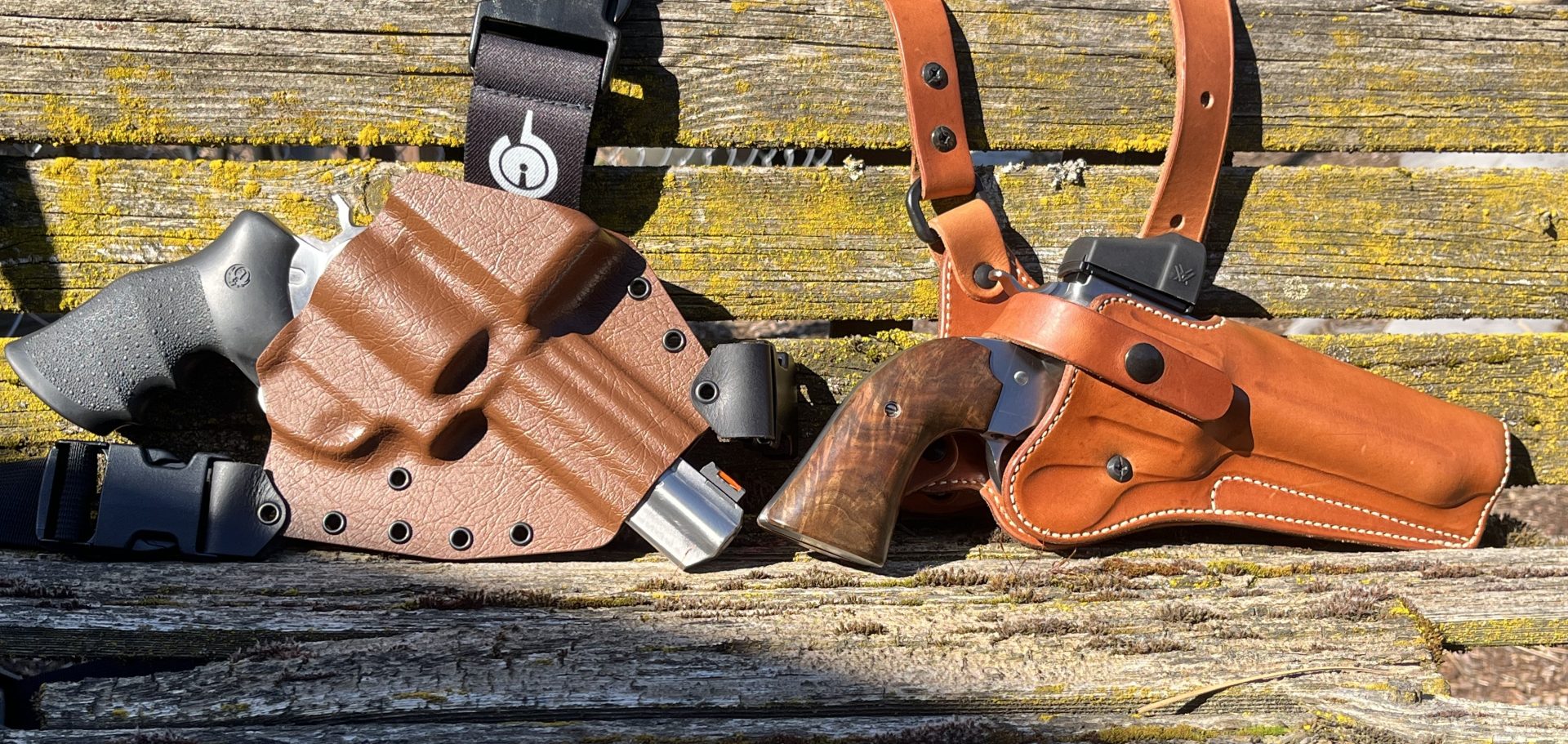
Right now, in the Kydex world, that conversation is dominated by one design: the GunfightersINC Kenai Chest Holster in its revolver configuration. In leather, the field is slightly broader, but still limited, and the Diamond D Custom Leather Guides Choice Chest Holster remains one of the most established patterns—now also adapted to clear modern optics.
Two materials. Two philosophies. Both now carrying guns that look very different than they did even ten years ago.
The Kenai is built around certainty.
A molded Kydex shell captures the revolver with deliberate tension, holding it in place without straps or snaps. The revolver version isn’t simply cut to clear a red dot optic—it’s molded with an integrated protective shroud around it, which is why the geometry has to be built into the form from the start. Sight channel geometry and optic height aren’t afterthoughts or allowances. They’re part of the mold itself. GunfightersINC builds around the actual configured firearm, optic installed, not a theoretical version of it.
The draw is consistent. Not fast in the abstract, but repeatable. The grip is always in the same place. The release is always in the same motion. Under stress, that predictability matters more than raw speed.
The harness system supports that idea. Wide, load-bearing straps distribute the weight of a heavy revolver across the torso instead of letting it hang from a single point. Buckles are positioned where they can actually be adjusted in the field. There’s enough structure to keep the gun from shifting, even when you’re moving over uneven ground, climbing, or working through brush.
And most importantly, it doesn’t change.
Rain in the Cascades. Snow in the late season. Sweat from climbing a ridge in early fall. Kydex doesn’t care—it doesn’t absorb any of it. The holster you strap on in the morning is the same one you’re wearing at dusk. No softening, no tightening, no gradual shift in how it holds the gun.
That’s the appeal.
And it carries with a certain mechanical honesty. Nothing hidden. Nothing soft. Just a tool doing exactly what it was designed to do.
In a place like the Pacific Northwest—where black bears are common, cougars are real, wolves are present in certain regions, and the occasional grizzly or protective moose can turn a normal day into something else entirely—consistency is not a luxury. It’s part of the equation.
One of the more understated details is how it’s built. The Kenai shell isn’t held together with exposed fasteners that can loosen or back out over time—it’s riveted as a unit. There’s nothing to periodically check, nothing to snug down, nothing that slowly works its way loose after a season of hard use. It’s designed to stay exactly as it left the factory, even after years of being bounced across shoulders, brush, and weather.
Kydex, of course, doesn’t stop at function. It shows up in every pattern imaginable—camo, carbon fiber, flat dark earth, and colors no one has ever seen in nature. None of it changes performance. A bear isn’t going to pause and reconsider because your holster is pink. But it does give the owner a sense of personalization that leather never really chased.
Leather approaches the same problem from the opposite direction.
The Guides Choice is built from heavy, molded leather, shaped to the revolver and suspended from a harness designed for long wear. On red-dot revolver models, a leather retention strap snaps over the firearm and is released as part of the draw stroke. Beneath that, the holster still relies on fit—carefully formed around the contours of the gun—to create retention that feels natural rather than mechanical, with an adjustable tension screw near the trigger guard to fine-tune the hold.
It’s a different kind of confidence.
Draw the revolver, and the motion starts with a practiced sweep of the strap, followed by the subtle resistance of leather yielding to the gun. Not abrupt. Not staged. Just deliberate. It feels less like overcoming hardware and more like taking the revolver from where it belongs.
Where leather separates itself is over time.
It changes.
Not in a way that compromises function if it’s cared for, but in a way that reflects use. Edges soften. Surfaces pick up marks. The holster develops a kind of memory—of the gun, of the environment, of the miles behind it. It carries its own history. For a lot of people, that matters more than they expect.
Comfort follows that same path. Leather conforms, distributes pressure, and tends to settle into the body over long days. Whether you’re hiking into elk country, glassing a basin, or moving through timber where visibility is measured in yards, that reduction in friction becomes noticeable.
It’s less about disappearing completely and more about becoming familiar.
There are tradeoffs, but they’re not the ones people usually argue about.
Leather requires attention. Not constant, but intentional. It needs to be dried properly when soaked, conditioned when it dries out, and generally treated like the organic material it is. Ignore it long enough, and it will show.
And while modern leather holsters—especially well-built ones—maintain their structure well, they still behave differently than a rigid shell. The feel of the draw, the way the gun seats, the interaction between holster and firearm—all of it has more variation. Not unpredictability, but character.
Put both into the environments that actually matter, and the differences in how they get there become clearer.
Hiking in predator country—whether you’re thinking about black bears in the timber, cougars that you’ll never see until they’re close, or the less predictable threat of another human—the requirement is simple: the gun has to be accessible, secure, and present without getting in the way.
Both systems do that.
The Kenai keeps the revolver locked into a fixed position on the chest, unaffected by weather or miles. It’s the same on the first step and the last. If your priority is a system that removes variables, this is what that looks like.
The Guides Choice carries the revolver just as securely, but with a different feel. It tends to conform and move more naturally with the body over time. Over the course of a long day—especially one measured in slow movement instead of constant motion—that distinction becomes more noticeable.
In a hunting context, the revolver is usually a secondary tool. A backup. Insurance. Something you hope stays exactly where it is. Noise from the draw, in that moment, is not a deciding factor. When you need the gun, the situation has already shifted from the hunt to the hunted.
What matters is that it’s there, in the same place every time, and that it comes free without hesitation.
Both leather and Kydex accomplish that. They just get there differently.
What’s changed—quietly, but significantly—is that the revolvers riding in these holsters are no longer the same ones we carried a generation ago.
Add a red dot to a large-frame revolver, and you extend its practical range. You speed up target acquisition. You make accurate shooting more attainable under less-than-ideal conditions. For many shooters, especially those whose eyesight isn’t what it used to be, it’s the difference between carrying a revolver and actually using it well.
That used to come with a tradeoff: you couldn’t carry it easily in the field.
Now you can.
Holsters like the Kenai and the Guides Choice—properly cut for optics—have closed that gap. The “range gun” and the “field gun” are no longer separate categories. They’re the same revolver, doing both jobs.
And that changes the equation.
In the end, this isn’t a question of which holster is better.
It’s a question of what kind of certainty you prefer.
Kydex gives you mechanical consistency. It doesn’t change. It doesn’t adapt. It simply performs the same way, every time, in every condition you’re likely to encounter.
Leather gives you something else. It adapts. It settles in. It becomes familiar in a way that no synthetic material does. It carries not just the gun, but the evidence of where it’s been.
Both will carry a large-caliber revolver with a red dot through bear country, through thick timber, through the kind of places where problems don’t announce themselves ahead of time.
And when something does go wrong—when the story you’ve heard a dozen times starts to feel a little too familiar—you won’t be thinking about materials.
You’ll be thinking about whether the gun is exactly where it’s supposed to be.
That’s the only part that ever really counts.
© 2026 Griffon Hill. All rights reserved.