
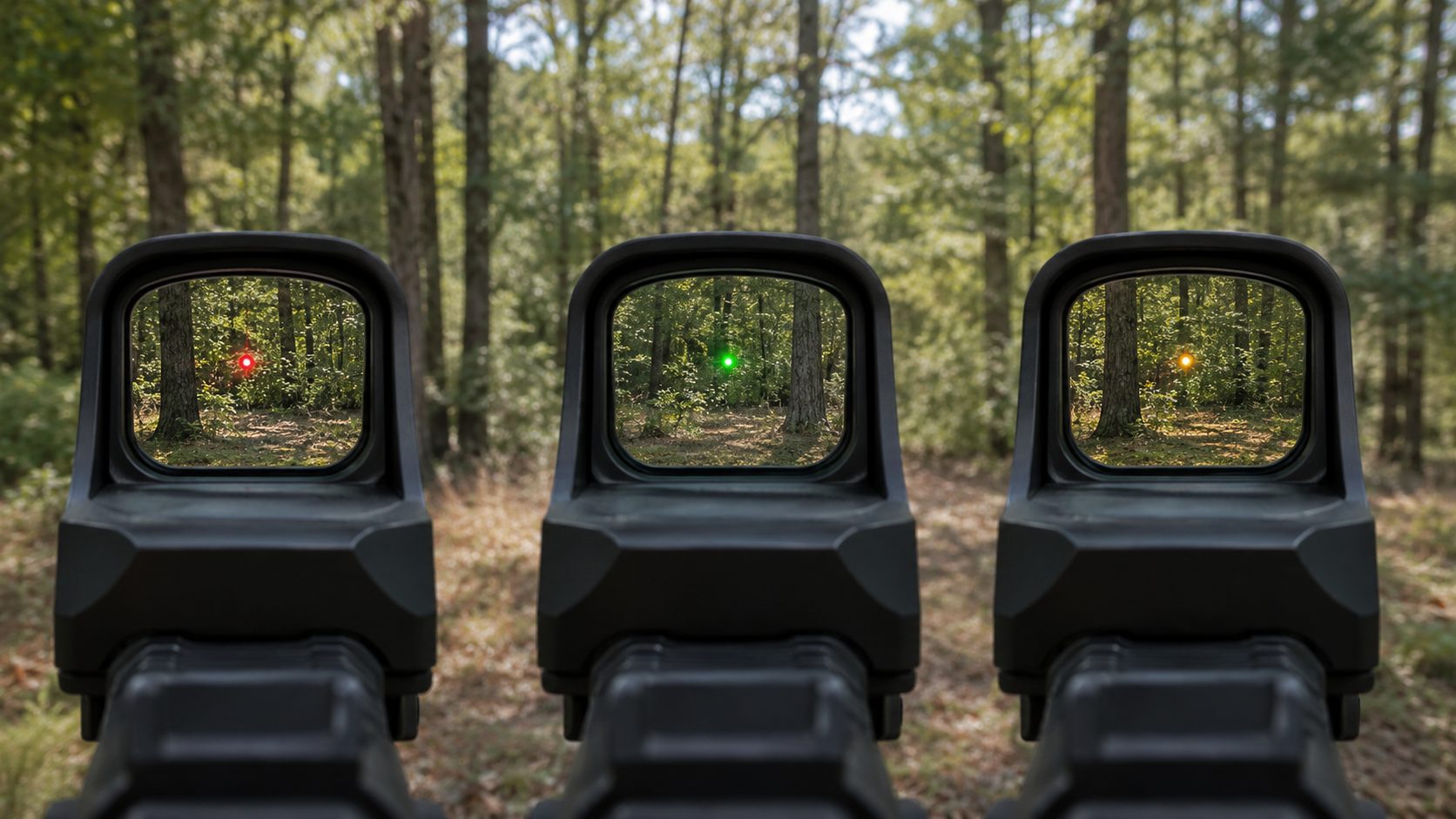
Red, green, and gold reticles all solve the same problem differently. The trick is knowing which color your eye can actually use.
A hunter eases into the edge of a clearcut just before last light. The revolver comes up. The black front sight starts to disappear into the dark shape of the bear, and the old question shows up again: Where exactly am I holding?
That is where a red dot earns its keep.
Not because it is trendy. Not because it looks modern. But because a glowing aiming point solves one of the oldest problems in handgun shooting: seeing the sight clearly against a changing background.
But the phrase “red dot” is starting to become a little outdated. Red is still the standard, but green dots have become common, and now Holosun has introduced gold reticles into the conversation. So the better question is no longer, “Should I use a red dot?”
It is: “What color dot should I use?”
The answer depends less on marketing and more on your eyes, your background, and the kind of light you shoot in.
Red: The Original Standard
The name pretty much sums it up. Red dots started as, well, red dots.
Red has been the traditional color for a reason. Our eyes are conditioned to notice it. Traffic lights, stop signs, brake lights, warning labels — red is used when something needs to grab your attention quickly. It is not especially common in most natural backgrounds either, which helps it stand out against timber, dirt, grass, hide, paper, and steel.
On a revolver, especially one used for hunting or field carry, red still makes a lot of sense. Against a black target, a dark animal, or a shaded timber background, a red dot gives you an aiming reference that iron sights simply cannot match. Open sights can leave you guessing in poor light. Black rear notch, black front blade, black hide, fading evening light — that is not exactly a recipe for precision.
A red dot cuts through that.
Red also tends to feel familiar. Most shooters who have used pistol optics, rifle optics, or even illuminated scope reticles have some experience with red illumination. It is easy to find, easy to understand, and widely available.
Where red can fall short is with certain eyes. Some shooters see a clean dot. Others see a comma, smear, cluster, starburst, or little glowing firework. That is often where astigmatism enters the conversation.
It is not always the optic’s fault. Sometimes the dot is perfectly round, but your eye is bending the light in a way that makes it appear distorted. A quick test is to take a picture of the reticle with your phone. If the camera shows a clean round dot, but your eye sees a starburst, the issue is probably your eye, not the sight.
Brightness matters too. A dot that is turned up too high will often bloom, especially indoors or in low light. Many shooters blame the optic when the real fix is simply to turn the dot down until it becomes crisp again.
Green: Easy to See, Sometimes Easier to Focus
Green dots have become popular for a reason. To many eyes, green appears brighter and cleaner than red at the same apparent intensity. It tends to jump out quickly, and some shooters with astigmatism find that a green dot looks more uniform than a red one.
That does not mean green is magic. It does not correct astigmatism, and it will not look perfect to everyone. But for a lot of shooters, especially those whose red dots look smeared or flared, green is worth trying.
Green also performs well in bright daylight. It can be very fast to pick up on paper targets, steel, and open shooting bays. On the range, where backgrounds are usually tan, gray, white, black, or painted steel, green can be extremely easy to track.
Where green can fall short is in certain natural environments. A green dot can still be very usable in the woods, but it may not always separate as strongly from heavy vegetation, spring grass, or green timber backgrounds. That does not mean it disappears. It just means the contrast advantage depends on what you are aiming at and what is behind it.
For hunters, this is worth thinking through. If your revolver spends most of its time in dry country, open sage, burned timber, dirt, snow, or dark timber, green may stand out beautifully. If you hunt in lush green cover, red may still offer better contrast.
Again, the eye gets a vote. Some shooters see green sharply. Some see red sharply. Some see both poorly. Others see both just fine and simply prefer one color over the other.
Gold: The Interesting New Middle Ground
Gold is the newest color in this discussion, and Holosun’s gold reticle is probably the most interesting recent addition to pistol optics.
Gold sits visually somewhere between red and green. It has more warmth than green, but it is not the same deep red most shooters are used to. Think amber, yellow-gold, or a bright brass-like aiming point rather than a traditional red LED.
The idea is contrast.
Gold can stand out well in bright light and visually busy backgrounds, but like every reticle color, it is not immune to blending in. That matters because not all shooting happens against clean paper targets. In the field, you may be aiming through branches, over dry grass, across snow glare, into shadows, or at a target that gives you very little clean contrast. A reticle color that your eye can separate from that mess has real value.
Gold may also appeal to shooters who find red too harsh and green too intense. Some eyes may pick up gold quickly without the same bloom or smear they see from other colors. But just like green, gold is not a universal answer. It is another option, and its usefulness depends on your eye and your environment.
Where gold might fall short is availability and familiarity. Red and green are established. Shooters know what to expect from them. Gold is newer, and not every optic line or footprint will offer it. Some shooters may love it immediately. Others may find that it blends into tan dirt, dry grass, or sunlit backgrounds more than they would like.
That is the tradeoff with every reticle color. One background’s advantage can become another background’s weakness.
There are two more things most shooters overlook: brightness and dot size.
Shooters sometimes assume one color automatically lasts longer than another, but the real answer depends on the optic, the emitter, and the brightness setting. A green or gold dot that your eye picks up easily may be usable at a lower brightness level. A red dot may need to be turned up in certain conditions. Or the opposite may be true for your eye.
Color matters, but brightness discipline matters more.
Run the dot only as bright as conditions require. You will usually get a cleaner aiming point, less bloom, and better battery life. Most shooters turn the dot up until they cannot miss it. That works, but it can also make the dot look larger, fuzzier, or more distorted than it really is. The goal is not to make the reticle as bright as possible. The goal is to make it bright enough to see clearly without overpowering the target.
Dot size is the other half of the equation.
A smaller dot can feel more precise on paper or at distance. A larger dot is usually faster to find, especially on a handgun under field conditions. For close-range hunting, defensive use, or aging eyes, a larger dot may be easier to live with. For slow, deliberate shooting, a smaller dot may give you more confidence.
This is where revolvers are a little different from the flat-range pistol conversation. A hunting revolver may be used in dim timber, from an awkward position, or with cold hands and a pounding heart. In that moment, the dot has to appear fast and make sense immediately.
A tiny dot that looks perfect from a bench may not be the best choice in poor light. A larger dot that looks a little bold on paper may be exactly what your eye needs in the field.
The right color still has to be paired with the right size.
That brings us back to the real question. Not which color is best, but which color your eye can actually use.
Red is still the safe standard. It is familiar, proven, widely available, and excellent against many hunting and range backgrounds. If you want the traditional answer, red is still it.
Green is often the easiest for many eyes to pick up quickly. It can appear bright, sharp, and fast, especially on the range or in open country. For shooters who struggle with red starbursting, green deserves a serious look.
Gold is the new wildcard. It may offer a useful balance between contrast, speed, and visual comfort, especially in bright or complex environments. It is not replacing red or green, but it gives shooters another way to match the optic to their own eyes.
If possible, look through all three colors outdoors, not just under gun-shop lighting. Indoor lighting can lie. A dot that looks perfect under fluorescent lights may bloom in the woods, wash out on snow, or disappear against a sunlit hillside.
And that is really the point.
A red dot sight is not just a mechanical part bolted to the revolver. It is an interface between the gun, the optic, the target, the background, and your eye. The mount has to hold the optic solidly. The optic has to hold zero. But the reticle has to do something just as important: it has to make sense to your vision the instant the gun comes up.
Red, green, or gold — the best dot is the one your eye finds fast, sees cleanly, and trusts when the light is less than perfect.
Because when the shot matters, the color printed on the box matters a lot less than the color your eye can actually use.
